Bridging The Geographical Gap: Introducing Investintech’s Belgrade Office

We just switched up our main Facebook  page photo with a spectacular photo of a place that can’t be found anywhere in the world. And rightly so.

The view is a unique one that is significant to us, here at Investintech, and it comes with a little bit of background we thought would help give the photo some context.

The Investintech View

You may not know it, but Investintech.com was founded as a finance related startup in early 2000 in Toronto, Ontario. The company was started by a small group of people just barely out of college who wanted to develop a platform that would enable professionals to be more efficient with financial reports.

The original start up faced a number of issues and challenges, and consequently, the focus after three years of hard work shifted towards data extraction from PDF files. On December 1, 2003, Able2Extract  v.2.0 was released. For the next four years, Investintech.com steadily grew, gradually developing more products such as Able2Doc, Absolute Server, and Sonic PDF Creator.

As business operations became more complex, the company opened an office in Belgrade, Serbia in 2007. Today that office is filled with more than 20 great colleagues and hard working individuals we are proud to have as members of the Investintech team.

And the rest, as they say, is history.

What you are looking at in the photo is the Investintech view from two different parts of the world, bridging the geographical gap between both offices.  You can see our Toronto headquarters facing our Belgrade counterpart in the awesome photo mashup our design team put together.

The photo represents two very iconic and distinct landmarks. You may already be familiar with the CN Tower skyline located in downtown Toronto.  The foreground, however, is from Belgrade. It depicts the plateau on which the statue of “The Victor,” the protector of Belgrade, stands. It resides in the part of the Kalemegdan medieval fortress that is the core and the oldest section of Belgrade. It stands on the cliff like ridge overlooking the confluence of the Sava River into the Danube. (Read more: http://bit.ly/4lD8Mm)

Sit back and enjoy the view!

Credit:

Mad Max Prhotography  https://www.facebook.com/MadMaxphoto
gtkenji http://www.flickr.com/photos/38969864@N03/

5 Great Able2Extract Tips for College Students

There are tons of college hacks that can make your academic life easier. From saving money to improving your study routine, building up efficient habits is key to surviving the year.  But have you ever considered developing a few PDF hacks to survive through an assignment?

For instance, take stock. How do you manage? Do you print up PDF files for taking notes and highlighting or do you read them off of your computer screen? How do you use PDF notes and research? Could you use a few PDF workarounds yourself?

Able2Extract has a few features that can do wonders on a PDF when you’re looking for a quick way to get things done. Here are some simple tips for some effective features.

1. Take Only the PDF Content You Need

As you know, professors oftentimes use the PDF format for handouts that can contain anything from related articles to lecture notes that can help you with your projects or research. Problem is you’ll usually need only certain sections, not the whole document.

Needing to take advantage of the material though, you’ll probably think of converting the entire file and deleting the chunks you don’t need.   With Able2Extract you don’t need to do that.  Use the mouse to highlight and select the content to convert. You can choose which pages, lines, or paragraphs you need while eliminating what you don’t want at the same time.

2. Work with PDFs AND OpenOffice

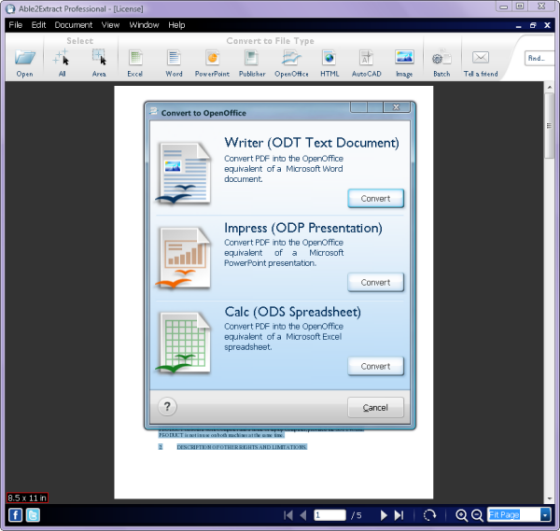
Not everyone has MS Office. In fact, you may choose to use a free alternative like OpenOffice. So what do you do when every PDF converter you come across only does PDF to MS Office conversions? Able2Extract can help you there, as well. You can get your PDF content in open source formats in just a few clicks.

Able2Extract Licence

Able2Extract can convert from PDF to Writer, Impress and Calc just as easily as it can convert from PDF to Word, PowerPoint and Excel.  The conversion process is the same. Just open, select and choose the PDF to OpenOffice conversion option on the toolbar.

3. Get Social by Creating Publications with PDF content

Involved with a few department clubs or student organizations? Throwing a fundraiser or setting up an information booth?  If so, you’ll probably need to get the word out or advertize your cause effectively. For most users, a DIY solution like Microsoft Publisher is all that’s needed to create high quality publications like newsletters and advertisements.

Well, you’ll be interested in knowing that Able2Extract can convert PDF to MS Publisher (.pub).  This means you can edit and create quality brochures or handbills yourself without having to start from scratch.  It’s a cost effective way to publish finalized advertising proofs in PDF format or quickly updating existing PDF fliers for your next student event.

4. Create PowerPoint Presentations Quickly

There are also the PDF files that are made from PowerPoint presentations conducted in class.  If your professor sets up a bulletin board on the web, he or she will more than likely post those PDFs online for easy access, building up a great resource for your own future presentations and assignments.

PDF to Power Point Tutorial

If you see a chart or slide you can refer to in your own presentation, why not convert the PDF to PowerPoint?  Able2Extract lets you convert either selected content or whole files. For entire PDF conversions, each PDF page you have will convert to a single individual slide. You can then edit and add as much as you need in MS PowerPoint itself.

5. Keep Research, References, and Quotes Digital

There are a lot of torrents and sites where you can find PDF versions of text books and novels for classes. If you find the version you need, you can then easily cut down on your work by keeping your research, references, and quotes digital. You can even convert them without having to actually “convert” anything.

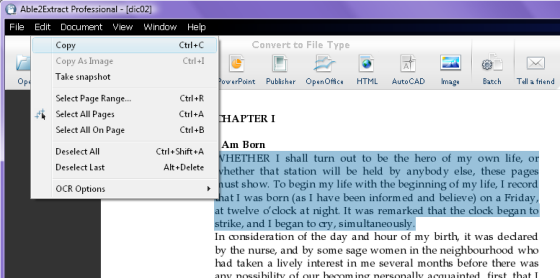
Copy and Paste Method Able2Extract

Instead of re-typing whole sections from the physical book into your essay, you can quickly use Able2Extract to copy and paste the text you need. Select a portion of text by using either the Copy option in the Edit menu or using Ctrl+ C, and paste it into the document you’re working on.

Try a few of these basic tips next time you come across a PDF and see how they work out for you.  If you’re looking for more specific user tips, let us know what you’d like to see. There’s always an easier way to do something with Able2Extract.

3 Different Ways To Post Your PDF On Facebook

Posting PDF files to Facebook

Everyone loves Facebook, and with good reason.  The social network has rolled personal networking, content sharing, and business marketing all into one platform.  And it’s due to things like Facebook fanpages that have made it easy for businesses and organizations to connect with their communities on a more personal level.

As a result, Facebook Fanpage administrators are always looking for different, more efficient ways to use them. In fact, one user had an excellent idea for her Facebook page that turned into an interesting question about PDF documents and Facebook Notes:

I would like to post a pdf (or Word) document to my Facebook page (not my personal page, to my business page). I would like to post it as a “Note” that everyone who has “liked” our business page can access. And I would like those who view the document to be able to print the document. Is that even possible.

It may sound like a simple thing to accomplish at first, but unfortunately, after some searching, we couldn’t find a direct way to do this. But we did manage to find a few interesting workarounds that came close, and we thought they were worth sharing.

Posting PDF Files With A Link

The first method involved sharing the PDF document as a link, which was probably the simplest way to post a document within a Note:

… We looked into this and, unfortunately, the only things you can embed within a note is an image and a hyperlink. Thus, the only straight forward way to add a document is through a URL linking to the document in your note (such as the Share link provided by our conversion apps or by websites like Scribd.com). And you can only restrict who sees the entire note with the Privacy option.

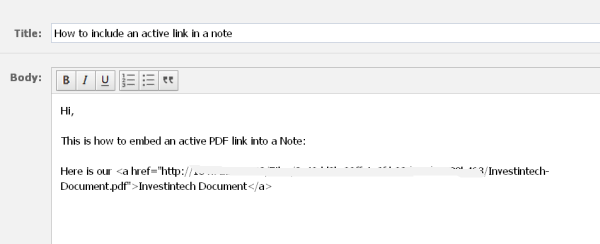
You’ll only have a link to your document, not the actual document itself.  But, on the bright side, you can make the PDF URL an active link by using the HTML tags:  <a href=“ Your PDF link here” >Your text here</a>   with your link and hyperlink text:

 Facebook Notes Adding HTML Tags

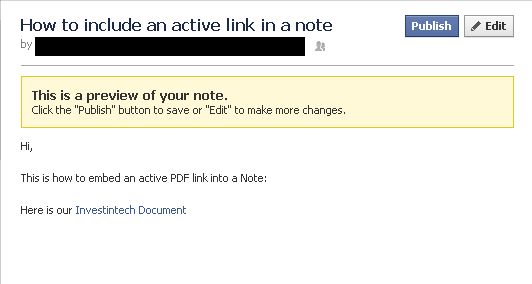
To check your link, hit Preview. The HTML tags should disappear, leaving you with an active link in your Note:

Active PDF Link

Using a link to post a PDF works with group, fanpage, and personal Walls, as well. The only difference is that you have to post the .pdf link into your Facebook status like you would with any web link you want to share on your Wall.

Code Your Page Using Static HTML: iframe tabs App

The second option we were able to find, while a bit more technical, was more visually appealing than using a link:

If you’re a bit tech savvy with coding though, we found that it can be done via Static HTML: iframe tabs App —https://apps.facebook.com/static_html_plus/?fb_source=search&ref=ts.  It will let you embed any type of code you want, including code for a PDF, and can be used for any Facebook app page. The PDF embed code can be provided from any document uploading site (http://youtu.be/UtBWa8dE36M ).

Here’s a direct look at the YouTube Video tutorial:

Using  JPEGs And Photo Albums

However, in the end, the user solved the problem by using a few creative tactics, offering yet a third way to do it:

I converted my documents to JPEG and placed them in “Photos”. Everyone who has access to the page can open Photos, then open an album, then right click on each photo/document page and “print photo”. It’s weird, but it works.

Indeed, it does work.  Even though the content was converted from PDF to JPEG, the PDF content was still viewable.  It was a great trick that even allowed her to restrict printing access only to fans.

If you found a handy solution for this issue yourself, let us know.  We’d love to add it to the list.

4 Cool Ways To View 3D Content In Your Browser

4 Cool Ways To View 3D Content In Your Browser

From reviewing to editing, projects with 3D CAD models require a lot of collaboration. Whether you’re dealing with engineering designs, architectural layouts, or manufacturing plans, you’ll need advanced applications, like AutoCAD, to generate and fully interact with 3D content.

Moreover, like PDF documents, files with advanced 3D content need special viewers.  However, most CAD applications offer built-in viewers directly within their software. So what if you or your clients don’t have immediate access to the necessary software?

That’s where these resources fit in.  These browser apps allow you to view and share 3D files without the original design software, making a bit of the CAD process easily accessible from anywhere and to anyone with an Internet connection and a browser.

Although these viewers don’t contain the heavy hitting features of full version CAD tools, each one of these has a couple of unique features for practical 3D image viewing online.

* Note that you’ll need a WebGL (Web Graphics Library) enabled browser, one that supports the JavaScript API that renders 3D graphics without a plug-in. These include Chrome 9.0+ , Firefox 4.0+ , Opera 11, and Safari 5.1+ (disabled by default).  (For more details, read Which Web browsers Can Run 3D CAD? by Ralph Grabowski).

GrabCAD

GrabCAD 3D Viewer
Source: http://grabcad.com/jair.meira-1

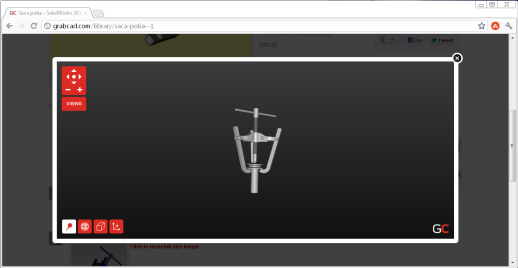
Here’s one viewer that was just recently launched by GrabCAD, a community made up of a wide range of engineers with their own expertise.  Their 3D viewer is perfect for sharing uploaded content with others who don’t have a CAD application to view it in.

Anyone can view a model by selecting it and clicking on the “View in 3D” button below it.  Once the model is opened in the viewer, you can annotate, zoom, rotate and translate the model. To boot, there are some great public 3D models on this site which you can check out without having to download.

GrabCAD members who upload their work have profiles and contact information available, which makes it perfect if you need to get in touch with them or get a quick sample of other work they’ve done.

Online 3D Viewer

Online 3D File Viewer

Online 3D Viewer is another great viewer that made the list. It allows you to quickly upload your files and view your local 3D models online. You can open files by clicking on the icon or simply drag and drop them. Supported formats are 3DS, OBJ, STL and more.

Sketchfab

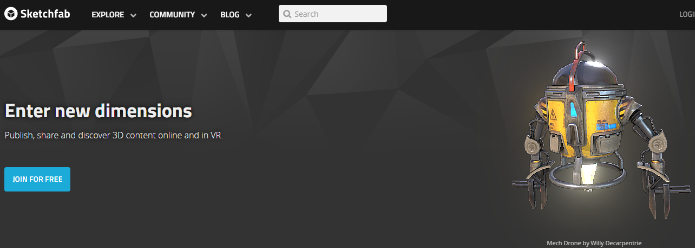
Sketchfab is a website for publishing, sharing and discovering 3D and VR content. There are a lot of handy features that come with this tool.

It allows you to easily display 3D models on the web and view them on any browser, mobile, desktop, or a Virtual Reality headset. You can upload the unlimited number of models from your software or your browser and embed them directly on Facebook, blogs, forums or any other site.

Online 3D Content Publisher

The main product of Sketchfab is a 3D and VR model viewer that enables you to move freely around or inside the 3D scene. In addition to static 3D models, the viewer is able to play and control 3D animations and make those models viewable in headsets. The tool relies on the WebGL JavaScript API to display 3D on web pages in all modern web browsers.

P3D.in

 P3D Screenshot

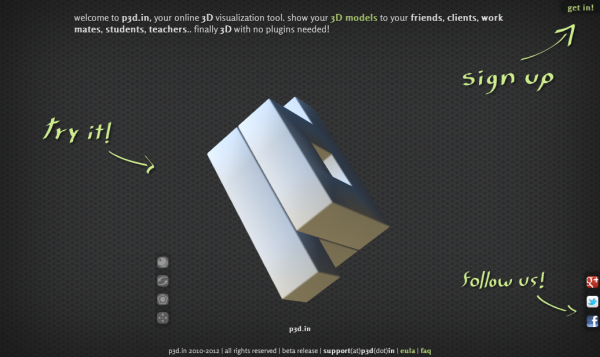
P3D.in is an online service for importing, viewing and sharing your 3D models.  Although you can opt in for a paid account with extended features, this tool is completely free to use.

Features include: support for Wavefront Obj. files, unique sharing URL generation for uploaded models, privacy options for viewing, navigation settings, model manipulation functions, viewing control options, embeddable HTML code, and 50 MB of storage space when you sign up. Visit their FAQ page for full details.

How to Translate PDF Documents Without Learning Another Language

Translating PDF files in different languages

It isn’t uncommon to come across PDF files in different languages. In fact, with the large global and international nature of the Internet, it’s hard not to come across one.

Whether it’s an online information brochure or an offline manual for a digital camera, a PDF file can come in all different types of languages.  However, one major issue is that, in most cases, you won’t be able to read in every different language fluently. So what do you?

Luckily, if you come across a PDF file in a different language, you don’t have to stress yourself out to learn a new language with a translation dictionary or database.  Here are some quick, easily accessible ways that can quickly get your PDF content into a language you can understand.

Google Translate

You may already know that Google can translate web pages, text, and phrases to and from 65 different languages. It’s as simple as adjusting your browser settings to auto-translate web pages or copying and pasting text to translate in the main Google Translate interface.

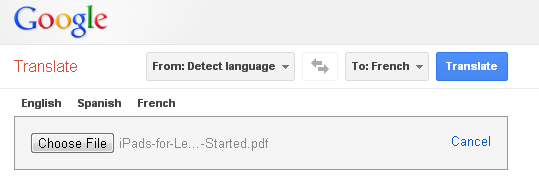
Google Translate PDF Translation

Well, translating PDF content with Google is just as simple. Once you’re on the main Google Translate page, click on the  translate a document hypertext link under the main text field.  You’ll get the above interface where you can click on Choose File to upload your PDF and select your target language.

However, one thing to note is that this tool is geared only towards translating the textual content; formatting and images aren’t preserved. Thus, you can expect this to work best when you need to translate and interpret large sections of text. When the translation process is done, your converted text will be available in a new tab in your browser.

Google Docs

While the above method doesn’t require a Google account, it’s quite possible that you already have one. If you do, and are already an avid user of Google Docs, then you can easily take advantage of its Translate Document functionality and use it on your uploaded PDFs.

Provided that your PDF was imported into Google Docs by selecting all the Upload settings to convert it to the Google Docs format (displayed when you upload a document), you should be able to open your PDF in the main editing interface with the main menu and formatting toolbars.

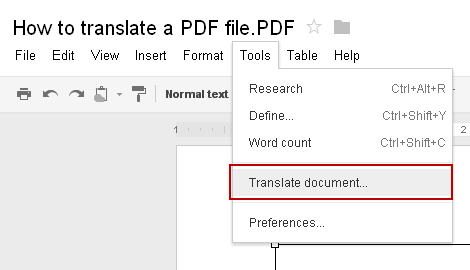
How to translate PDF file

With your PDF open in Google Docs, click on Tools and select Translate Document. You can then choose your desired language and click on Translate. The results will be generated in a new PDF file with both the original and translated versions included.

DocTranslator

Doc Translator Logo

Though the many ads on the site and interface may put you off, DocTranslator has a solid database, using the Google Translate service to process your textual content and containing translation support for more than 50 languages.  To boot, the site offers translation for a handful of popular formats without file size restrictions, including the PDF format.

Keep in mind that this tool should only be used for translating PDF content that isn’t sensitive, confidential, or in need of any sort of security at all (files such as manuals, brochures, fliers, etc.). The fine print on their privacy statement mentions that it doesn’t include PDF files. So you’ll have to use your own discretion on which PDF content you want translated.

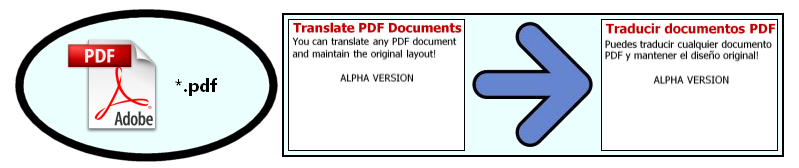
Doc Translator PDF

To access the PDF translation app, click and select the PDF option on the homepage, and you’ll be able to upload your PDF and choose your target language.  In contrast to Google Translate, DocTranslator  works towards retaining the formatting and layout of the file, though your results may vary.